The problem in context
India is ageing faster than its households are prepared for. Chronic conditions — diabetes, hypertension, thyroid, cardiac — arrive in clusters, and with them polypharmacy: four, six, sometimes ten pills a day, each with its own window. In a joint family, someone older was always around to hand over the next dose. In today's nuclear setup, the children live in another city, sometimes another country.
What looks like a memory problem is really a distance problem. The elderly parent manages a schedule they didn't design; the adult child manages anxiety they can't put down. Every missed dose is a phone call, and every phone call is a small erosion of the parent's independence. The routine is quiet, daily, and load-bearing — and nothing in the home currently confirms that it happened.
History — what came before
Medication management has been reinvented every decade, and each attempt fixed one slice.
Notes fade. Strips get confused. Organisers assume someone loads them correctly. Reminder apps notify a phone the elderly user doesn't check. Smart dispensers automate the pour but leave the caregiver still guessing whether the pill was actually swallowed.
The missing piece wasn't reminding people. It was confirming that the routine actually happened.
Geography — where it lives
The problem lives in ordinary apartments. A retired couple in a Tier-2 city manages their own mornings; their son works in Bengaluru, their daughter in Toronto. In Tier-1 metros, elderly parents often live alone in the same city as their children but on opposite ends of a two-hour commute. Either way, the caregiver is not in the room when the pill is due.
The home itself shapes the failure. Medicines sit on a dining table, a fridge top, a bedside drawer — wherever the last dose ended up. Vision drops after 65, labels shrink, and the phone that the reminder app talks to lives two rooms away. Distance, layout, and eyesight quietly conspire against adherence long before intent does.
Physics — forces at play
Two sets of forces act on every dose, every day.
- Long-standing daily routine
- Fear of relapse and hospital visits
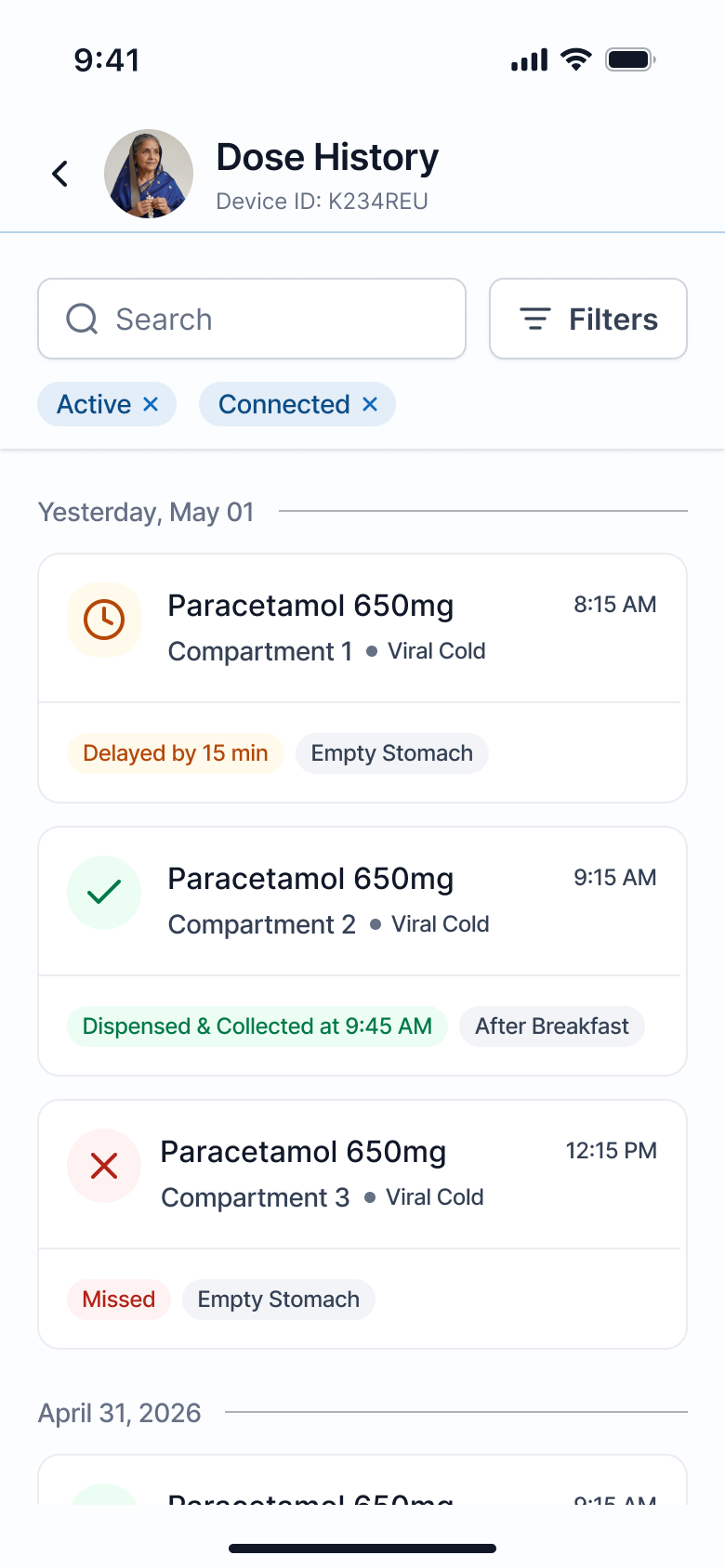
- Family pressure and love
- Doctor's authority
- Muscle memory from years of the same schedule
- Ageing memory and cognitive load
- Vision decline and small labels
- Distance from the caregiver
- Low comfort with phone-first technology
- Caregiver workload and burnout
Reminder apps only push against forgetfulness. They leave distance, vision, and caregiver anxiety completely untouched. A physical object in the home addresses all three at once.
Chemistry — what reacts together
One late lunch is enough to unravel the system. The medicine slides an hour. The caregiver's evening check-in returns silence. The next call is anxious, then insistent. The parent, defending their independence, brushes it off. Trust thins on both sides.
MedEase intervenes at the second link. The moment a dose is confirmed — or missed — the caregiver sees it without asking. The chain never reaches the phone call.
Biology — the living system
Adherence is not a feature of a device; it is the output of a small ecosystem working together. Remove any one part and the system stalls.
The doctor writes the schedule. The caregiver loads it. The routine carries it. The home makes the device visible. The device confirms the act. The app closes the loop back to the caregiver. MedEase only works when every actor stays in the loop — the product is the connective tissue between them.
Mathematics — the numbers
- Sustained adherence over 90+ days across chronic-illness cohorts
- Reduction in hospital readmissions linked to missed medication
- Retention of caregiver app usage beyond the first month
"I stopped calling my mother three times a day. I just look at my phone once, and I know."— Caregiver, 41, usability session 06
Design engineering
Eight decisions shaped what MedEase became.
- Confirmation over remindersThe product exists to prove the routine happened, not to nag it into happening. Every other decision follows from this.
- Physical-first, app-secondThe elderly user meets a lamp and a button, not a screen. The app is the caregiver's surface — it never sits between the parent and their medicine.
- Ambient lamp as primary UIA colour visible from across the room replaces reading a label. Green means done, orange means due, red means missed. No literacy or eyesight prerequisite.
- Physical compartmentsPre-loaded weekly compartments remove the failure mode of picking the wrong strip. Loading becomes a caregiver ritual, not a daily risk.
- Sensor-backed confirmationThe device detects that the correct compartment was opened and the dose removed — confirmation is grounded in an action, not a self-report.
- ESP32 as the brainChosen for BLE + Wi-Fi on a single low-power chip, mature firmware, and a bill-of-materials that keeps the device affordable at pilot scale.
- BLE + Wi-Fi togetherBLE handles local setup and offline confirmation when the network drops; Wi-Fi carries state to the caregiver app. Neither alone was enough.
- One-tap confirm buttonA single tactile button, sized and lit for aged hands, is the only interaction the elderly user ever needs. Everything else lives in software.
STAR — situation, task, action, result
India's elderly are managing more medicines than ever, from further away from their caregivers than ever. Reminder apps and pill organisers exist, but caregiver anxiety and missed doses keep rising.
Design a system that gives elderly users a routine they can trust and gives caregivers proof — not hope — that each dose was taken, without turning the parent into a phone-first user.
Ran 24 interviews with elderly users and caregivers, mapped the daily failure chain, prototyped both app-first and device-first solutions, and tested them side by side. The device-first prototype won on every measure.
A physical-first product with an ambient lamp, sensor-backed compartments, and a caregiver app that closes the loop. Confirmation replaces reminding as the core interaction, and caregivers stop calling to check.
Before & after
The shift is structural, not cosmetic.
| Before | After |
|---|---|
| Relying on memory | Physical guidance from the device |
| Caregiver phone calls to check | One-tap confirmation, visible remotely |
| Medicine strips on a table | Pre-loaded compartments with sensor feedback |
| Reminder apps the elderly user ignores | Exception alerts sent only when something is off |
| Uncertainty on both sides | Peace of mind for the caregiver, independence for the parent |
Final screens
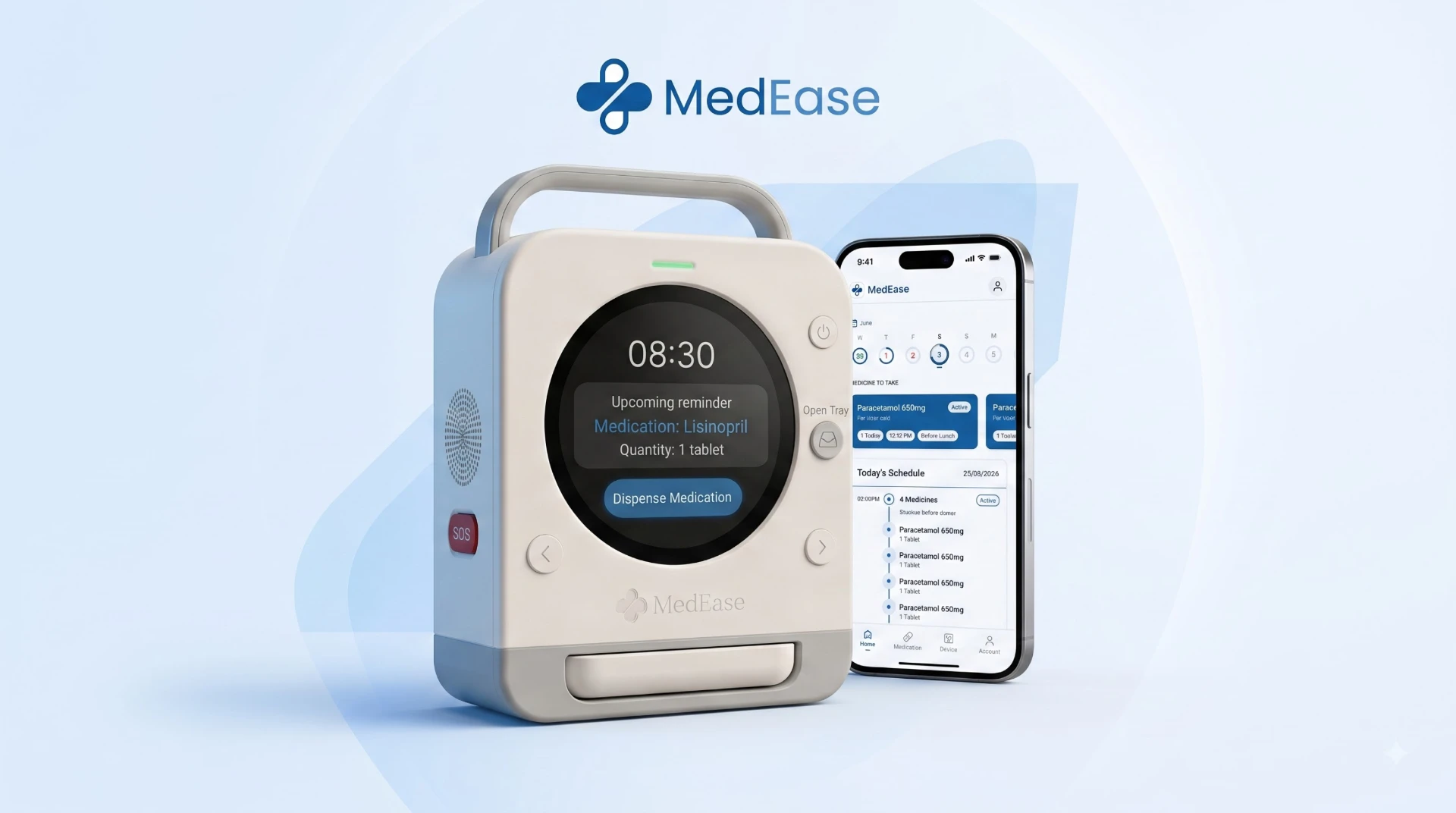
The product speaks through three surfaces: the device, the caregiver app, and the ambient lamp.
- HomeA calm resting state — time, next dose, and a single primary action. Nothing to decode when nothing is happening.
- Upcoming DoseA gentle heads-up ten minutes before, so the routine has time to arrive naturally instead of being interrupted.
- Medicine ActiveThe correct compartment lights up. No reading required — the light is the instruction.
- DispensingVisual and tactile confirmation that the right compartment opened, so the elderly user isn't guessing.
- Take MedicineThe one-tap confirm state — sized, lit, and worded for a 70-year-old at 7am.
- ConfirmationA brief, warm acknowledgement. Closure matters; the routine deserves to feel finished.
- Missed DoseA soft escalation, not a scold. The device stays kind; the caregiver decides what to do next.
- OfflineThe device keeps working locally; state syncs when the network returns. Adherence never depends on Wi-Fi.
- Low BatteryAn early, clear warning with a physical charging cue — designed to be resolved by a caregiver, not a manual.
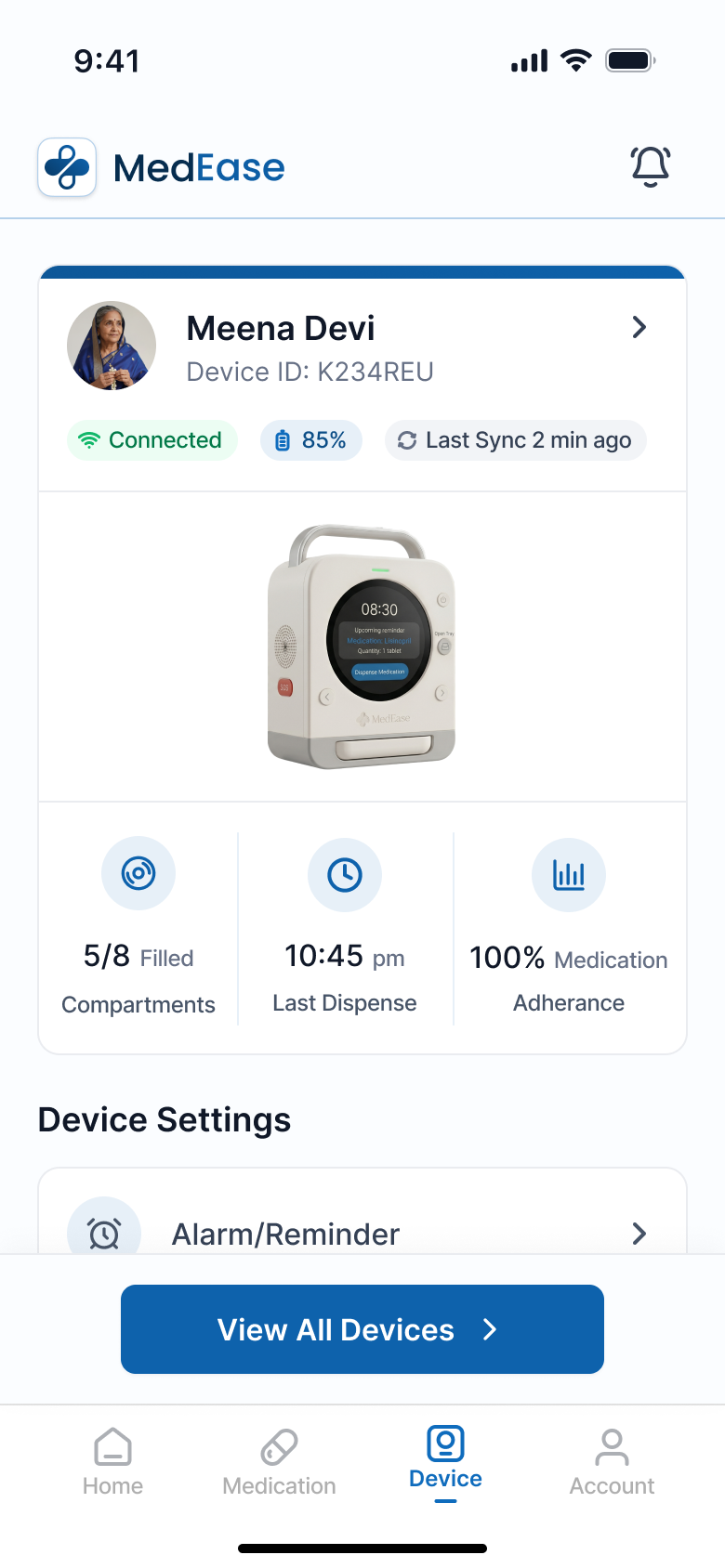
- DashboardOne glance answers the only question that matters: did today happen? Everything else is secondary.
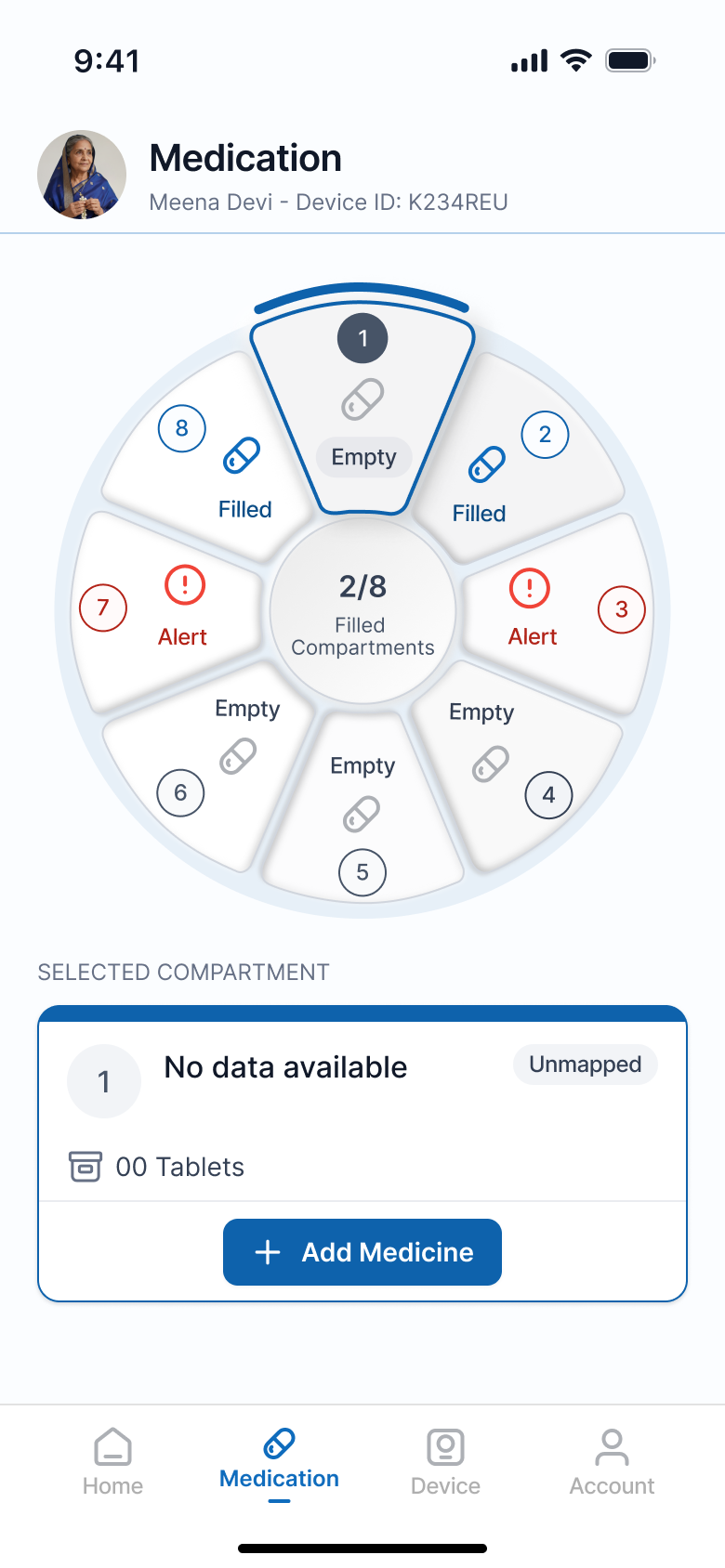
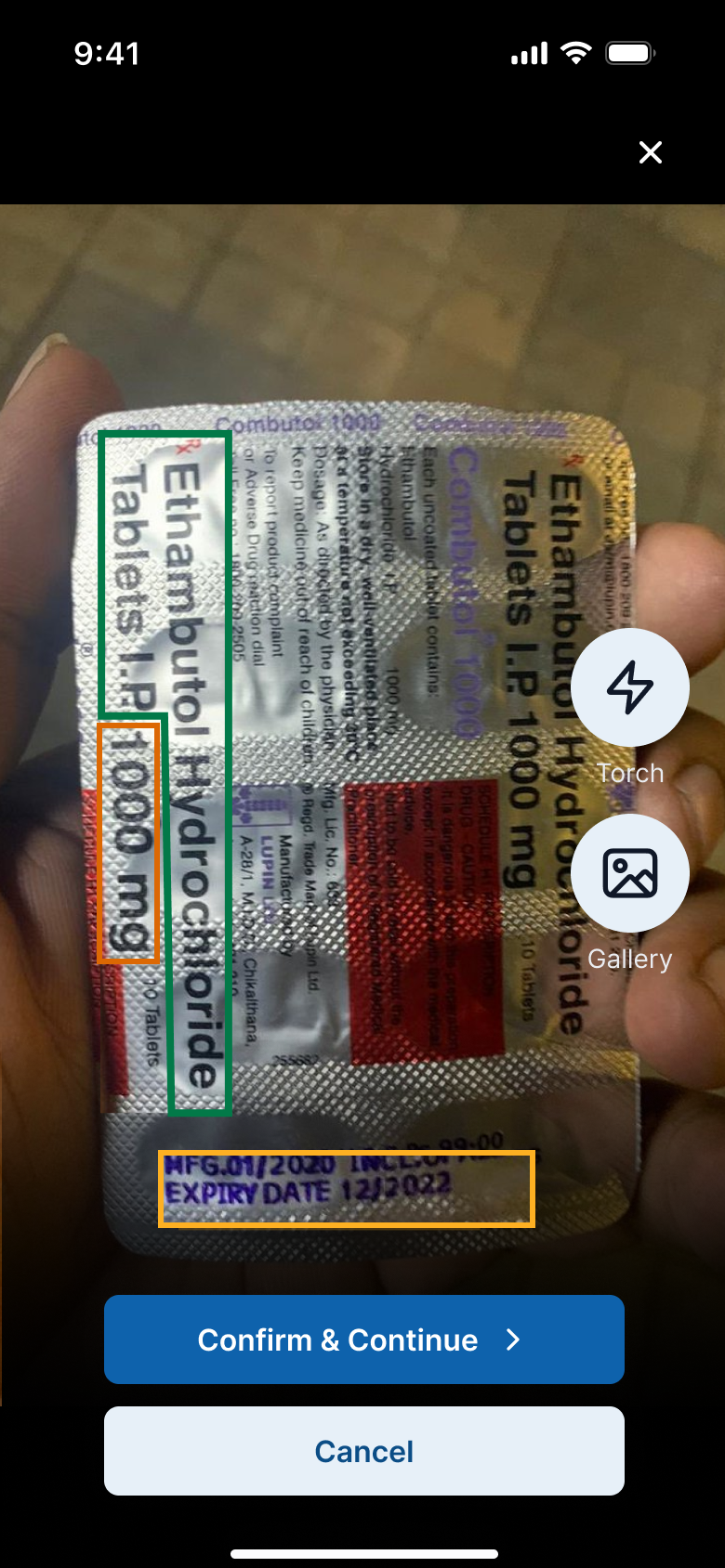
- Medicine MappingCaregivers assign medicines to compartments once. The device becomes an extension of the doctor's prescription.
- ScheduleDose windows, not rigid times — accommodates real life without breaking adherence.
- NotificationsSilent when things are on track. Loud only when something needs the caregiver.
- RefillPredicts when a strip will run out and prompts before the shortage becomes a crisis.
- SettingsContact numbers, escalation rules, and quiet hours — the caregiver decides how present the system is.


Learnings
We started convinced the problem was forgetfulness. The interviews rewrote the brief: the real pain was the caregiver's anxiety, not the parent's memory.
An app-first version tested worse than a paper prototype of the device. Elderly users did not want a screen in the middle of their morning.
Reminding is a feature; confirming is a product. Once we accepted that, half the roadmap simplified and the other half sharpened.
ESP32 with BLE + Wi-Fi wasn't a technical flourish — it was the only way to keep the device useful when the home network drops, which happens more often than any spec sheet admits.
Small-sample usability told us where the design worked; it did not tell us it would scale. We labelled those numbers as directional and moved on.
Caregivers, not elderly users, are the buyers. Pricing, packaging, and onboarding were rewritten once that became obvious.
Designing for someone who reminds you of your grandmother changes what you're willing to ship. It made the team slower in the right places.
Reminders tell you when. Confirmation tells you it happened. That single shift is the entire product.