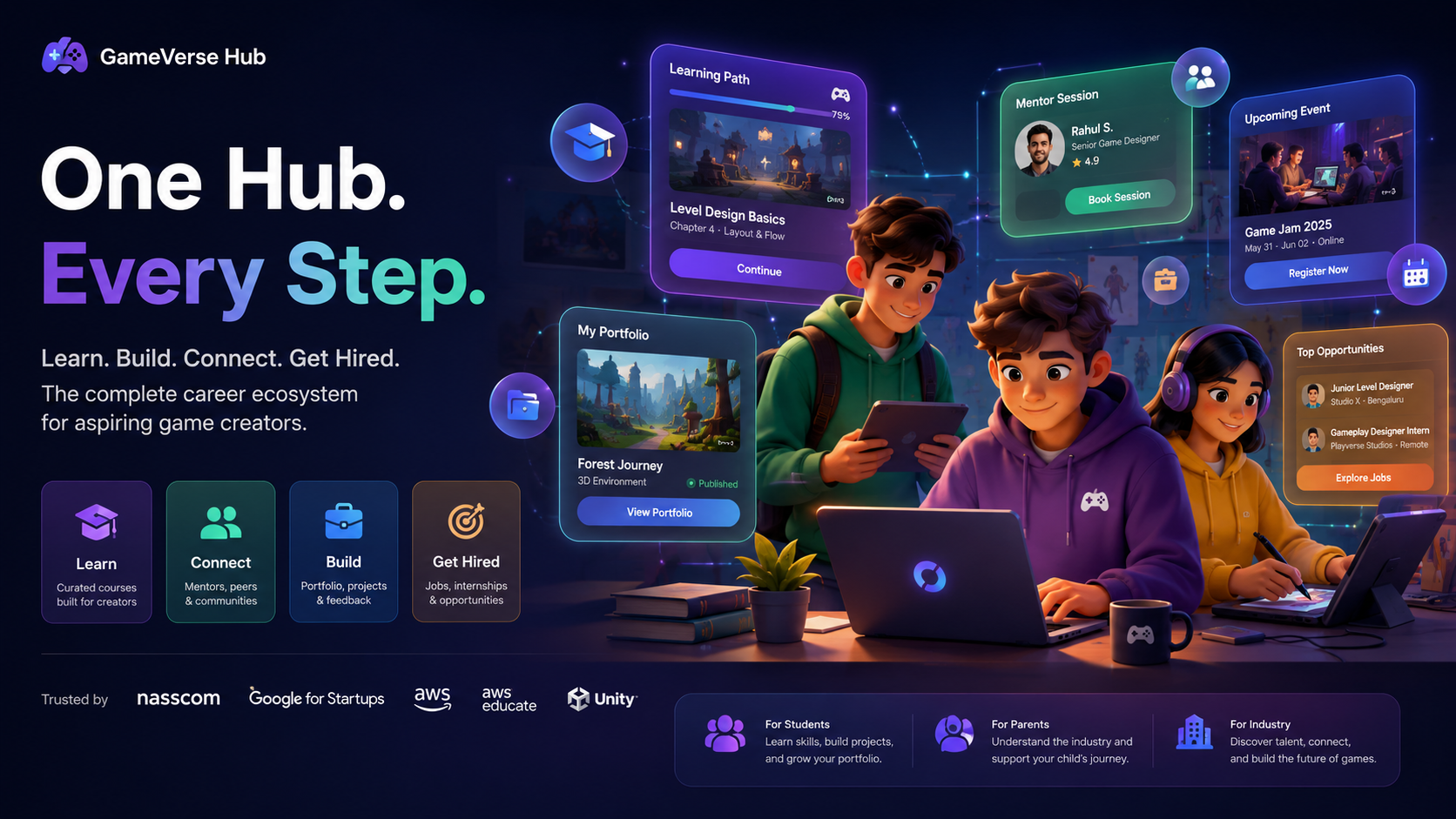
The problem in context
In India, wanting to make games and actually getting into the industry are separated by a maze. A student in a Tier-2 city can teach themselves Unity on YouTube, but the next steps — a mentor who has shipped a title, a portfolio that studios actually read, an internship that isn't a WhatsApp forward — sit on completely different platforms, in different languages, behind different sign-ups.
Every interview surfaced the same shape: motivation is high at the start, then decays as learning, mentorship, portfolio, networking, and hiring stay disconnected. Parents, who are quietly the biggest decision-makers, have nowhere to verify that game design is a real career. The problem isn't a lack of resources. It's that no single surface stitches them into a journey.
History — what came before
Aspiring creators already stitch together their own stack. Topmate lets them book a mentor call. LinkedIn is where studios post openings. Itch.io is where they publish a first build. Coursera and YouTube carry most of the learning. Wix and Notion become improvised portfolios.
Each of these tools does its one slice well. What's missing is the connective tissue — a place where the mentor call, the course progress, the shipped build, and the studio application are aware of each other and of the person moving through them. The gap isn't a better tool. It's an ecosystem.
Geography — where it lives
The audience lives outside the metros. Bengaluru and Hyderabad have studios and meetups; most aspiring creators do not. They're in Tier-2 and Tier-3 cities, in engineering colleges without a game design elective, in bedrooms where the PC is shared and the career conversation happens at the dinner table.
Discovery happens on YouTube, Discord servers, Instagram reels, and college gaming clubs — rarely on a single site. Any real solution has to meet users where they already are: mobile-first, low-bandwidth-friendly, and legible enough for a parent to browse alongside them.
Physics — forces at play
Two sets of forces shape whether someone actually pursues a game career.
- Genuine passion and play history
- Creative ambition — wanting to build, not just consume
- Curiosity about how games are made
- A visible Indian gaming culture
- A domestic industry that is finally hiring
- Parental skepticism about games as work
- Low awareness of specific roles and paths
- Financial uncertainty during the learning years
- No accessible mentorship
- Information scattered across ten platforms
Design decisions were judged by one question: does this weaken an opposing force, or amplify a driving one? Everything else was decoration.
Chemistry — what reacts together
Seven stakeholders share this journey, and they rarely talk to each other: students, parents, mentors, industry professionals, studios, colleges, and government bodies shaping the sector.
The design treats trust as the reactant. Parents need visibility into what the student is doing and who they're learning from. Mentors need context before a call so it isn't wasted. Studios need portfolios that are readable in under a minute. Colleges need a way to plug students into the industry without building their own program. When these groups can see each other's signals, guidance replaces guesswork.
Biology — the living system
A career isn't a checklist; it's a loop that runs for years. The product had to be designed for that loop, not for a one-time onboarding.
Every surface — courses, mentor sessions, portfolio, events, job board — feeds back into the student's profile so the next loop starts smarter than the last. Continuous engagement isn't a growth metric here; it's the shape of the actual career.
Mathematics — the numbers
Tier-2 and Tier-3 internet adoption keeps climbing, which is where the next wave of creators actually lives. Prototype usability numbers from testing are small-sample and directional — useful for pointing the next iteration, not for claiming outcomes.
Design engineering
Eight decisions shaped the build.
- Role-based onboardingA student, a parent, and a studio recruiter need different first screens — one funnel would have failed all three.
- Information architectureGrouped around the career loop, not around features, so navigation matches how users actually think.
- Design systemTokenised type, colour, and spacing so screens across seven stakeholder flows still feel like one product.
- AccessibilityAA contrast, keyboard paths, and readable body copy — parents skew older, students often browse at night.
- LocalisationCopy structured for Hindi and regional expansion; English never assumed as the default.
- Trust-first UXVerified mentor badges, transparent pricing, and parent-visible activity to earn permission, not just attention.
- Mobile-firstMost of the target audience meets the product on a phone before a laptop.
- Scalable architectureNew roles and content types slot in without a redesign — the ecosystem is expected to grow.
STAR — situation, task, action, result
India's gaming industry is expanding fast, but aspiring creators — especially outside metros — have no unified path from curiosity to career. Existing platforms each solve one slice.
Design a single ecosystem that connects students, parents, mentors, studios, colleges, and opportunities, and make it usable for a first-time visitor and a returning creator alike.
Ran stakeholder interviews, mapped the career loop, defined role-based flows, built an IA around the loop instead of features, and prototyped the highest-leverage surfaces: onboarding, mentor marketplace, portfolio, and jobs.
A validated blueprint for a connected career ecosystem with an 85% onboarding completion rate in prototype testing (small-sample). More importantly, a design system and IA that can scale as new roles and content join the loop.
Before & after
The shift is structural, not cosmetic.
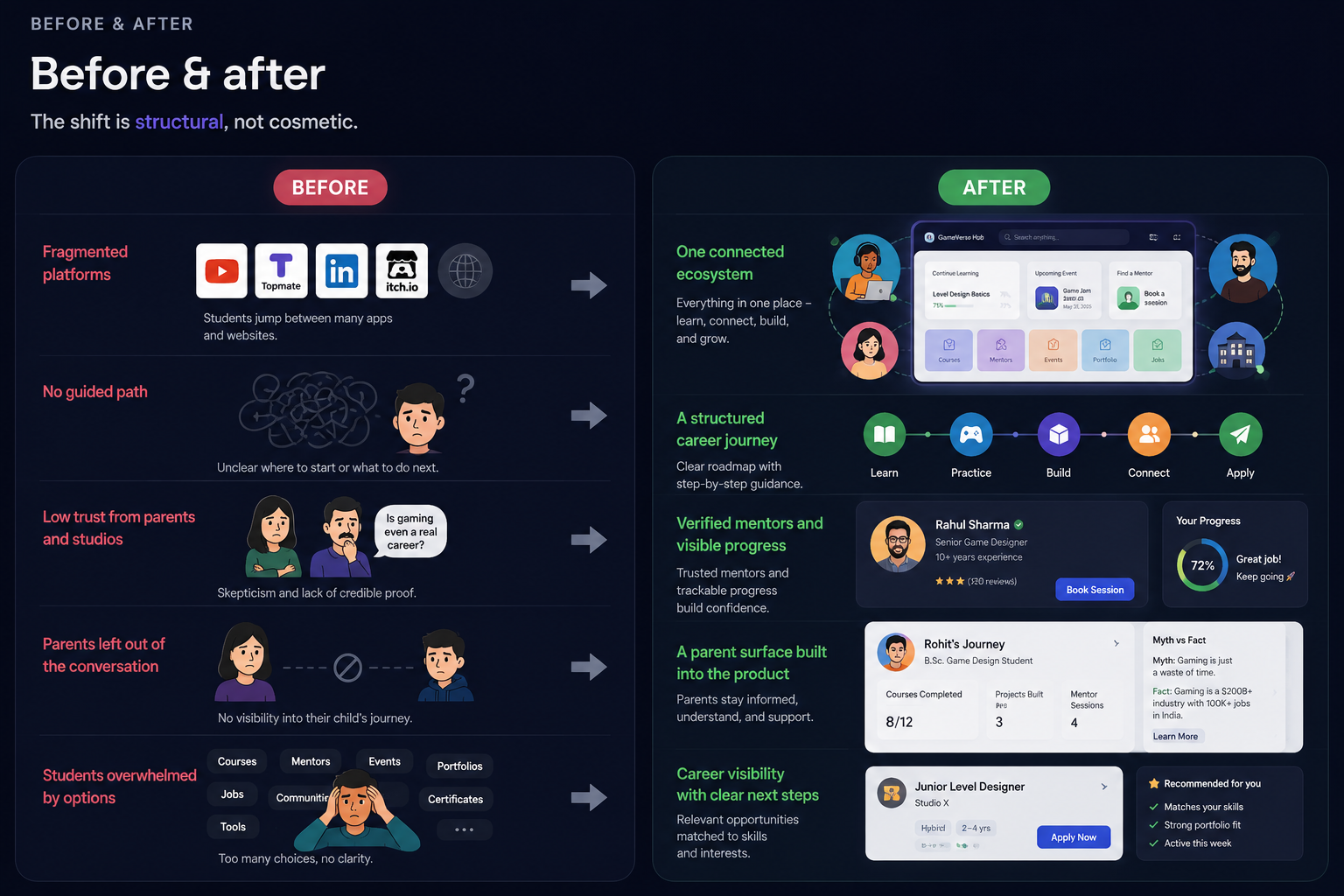
| Before | After |
|---|---|
| Fragmented platforms | One connected ecosystem |
| No guided path | A structured career journey |
| Low trust from parents and studios | Verified mentors and visible progress |
| Parents left out of the conversation | A parent surface built into the product |
| Students overwhelmed by options | Career visibility with clear next steps |
Final screens
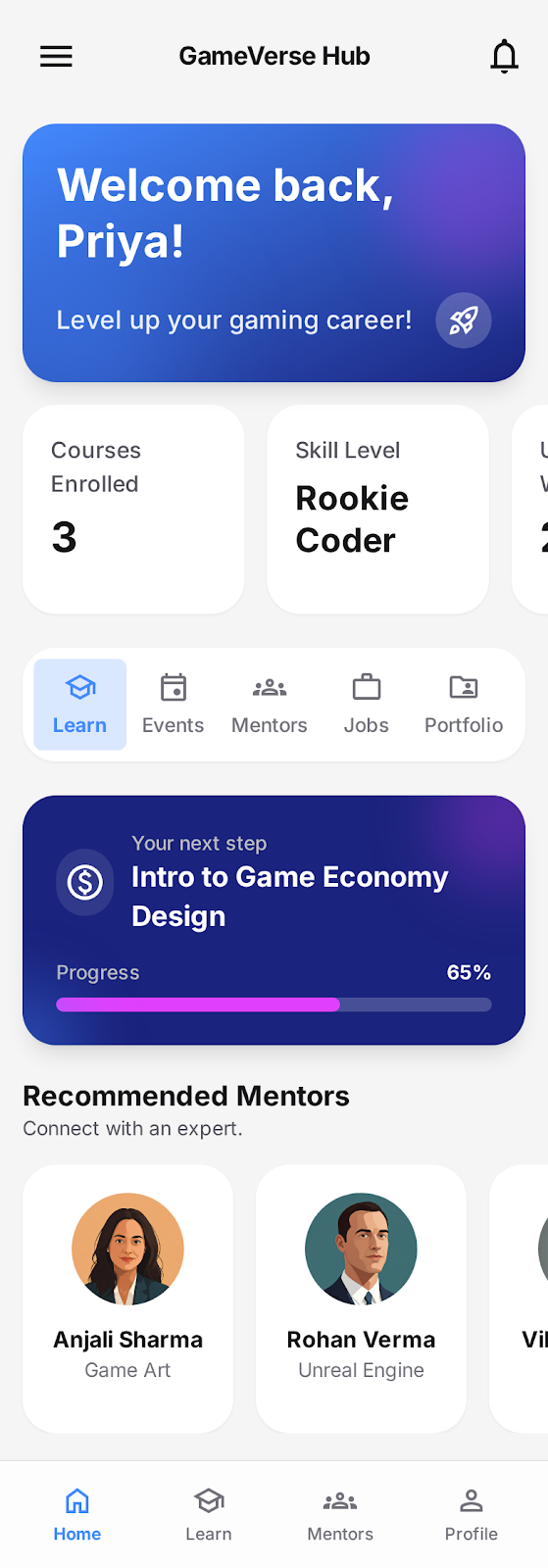
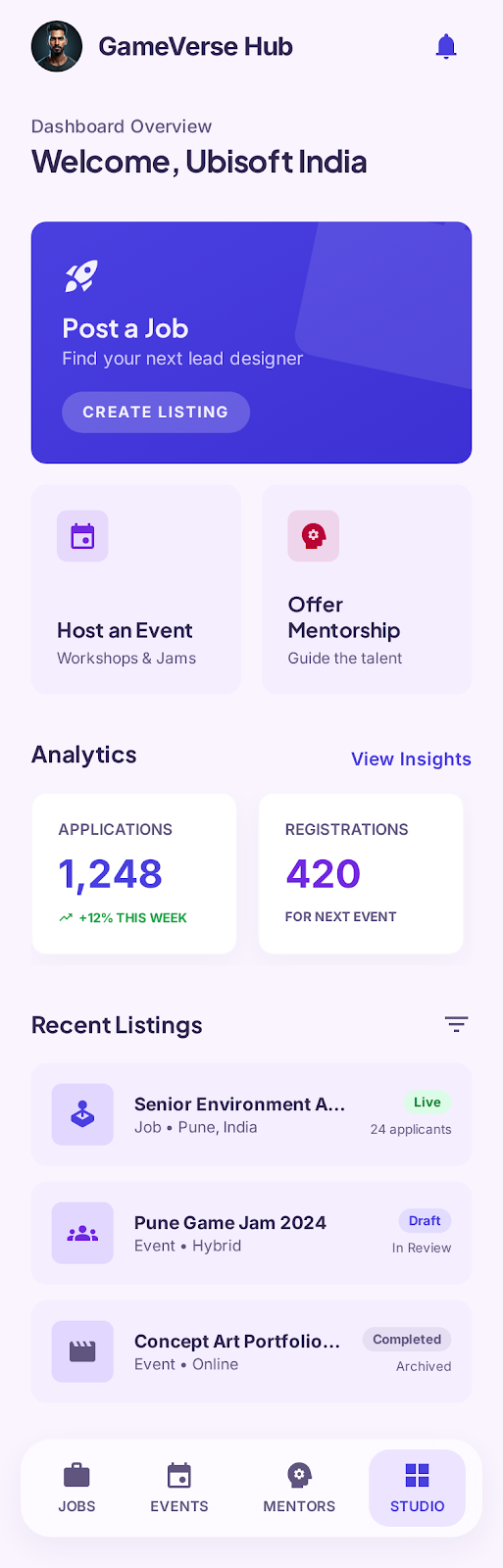
Nine surfaces do the work of the ecosystem.
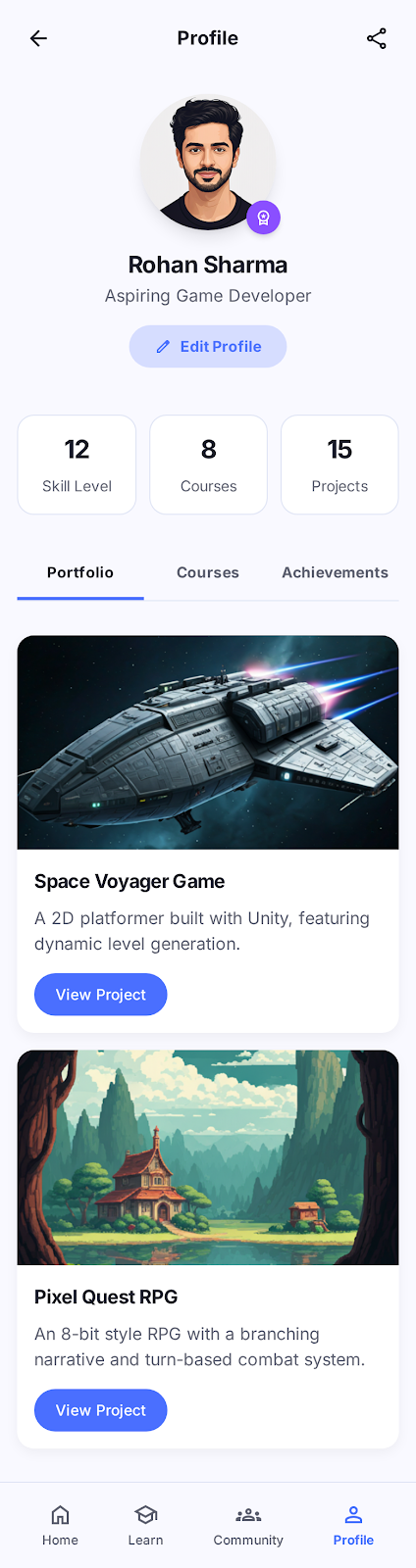
- Student DashboardAnchors the career loop — where the student sees progress, next step, and open threads across mentors, courses, and applications.
- Parent DashboardA calm view for the person quietly making the decision: what the student is learning, from whom, and where it leads.
- Learning HubCurated paths, not a course catalogue — reduces the paralysis of picking what to study first.
- Mentor MarketplaceVerified professionals with context-rich profiles so a session starts from signal, not small talk.
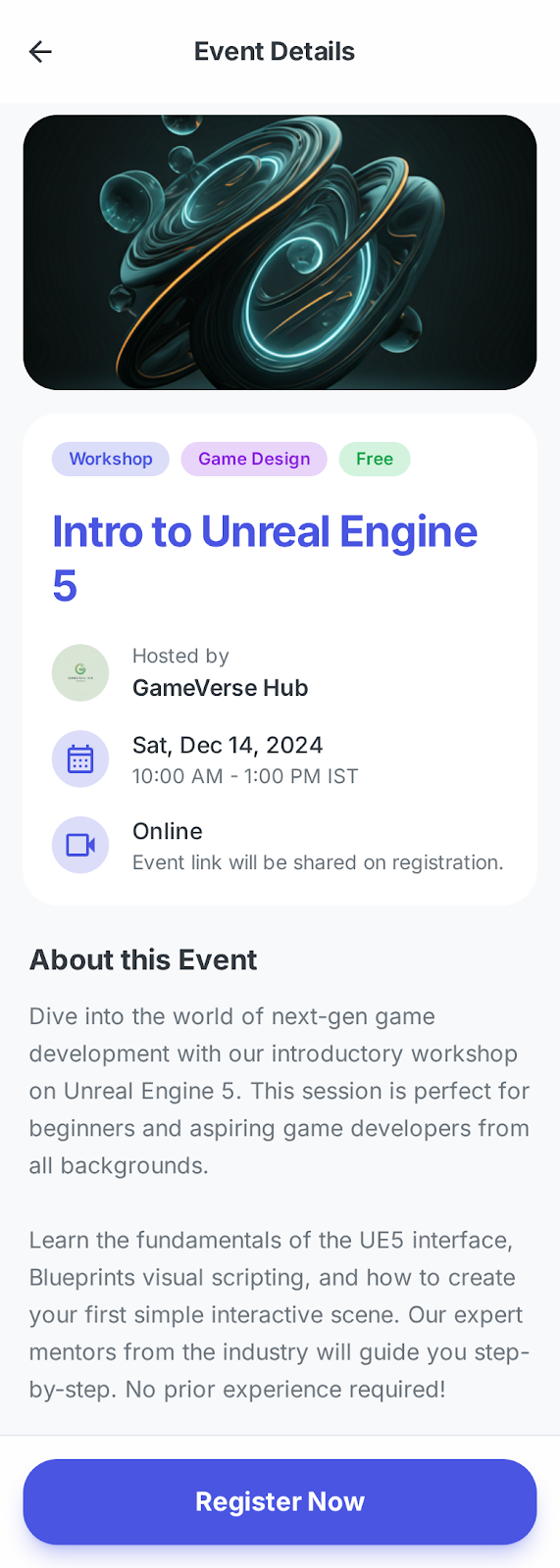
- EventsJams, workshops, and studio visits placed inside the loop so networking has a reason to exist.
- Portfolio BuilderA structured template designed for how recruiters actually skim — role, contribution, artefact, outcome.
- Job PortalRoles filtered by the student's real level so early-career listings aren't buried under senior openings.
- Industry DashboardStudios and colleges see verified talent pools instead of cold inbound.
- Settings / ProfileOne identity across the ecosystem — the same profile powers learning, mentorship, portfolio, and hiring.

Learnings
- 01Ecosystems are designed, not assembled. Stitching together existing tools produces a checklist; designing the connective tissue produces a journey.
- 02Trust outperforms features. A verified mentor badge moved behaviour more than any new screen.
- 03Research earns the right to design. The strongest decisions traced back to a specific interview, not a hunch.
- 04Multi-stakeholder UX means designing for the person who isn't in the room. Parents shape the outcome even when they never open the app.
- 05Localisation is a structural choice, not a translation task. English-default copy quietly excludes the audience the product exists for.
- 06Accessibility is the floor, not a phase. Contrast, keyboard paths, and readable body copy protect the widest audience for the least cost.
- 07Iteration beats certainty. Small-sample prototype numbers pointed the next move — they weren't the finish line.
- 08Systems thinking is the actual craft. The screens are the surface; the loop underneath is the product.
The biggest insight from this project was that the real problem wasn't the lack of opportunities—it was the lack of connected guidance.