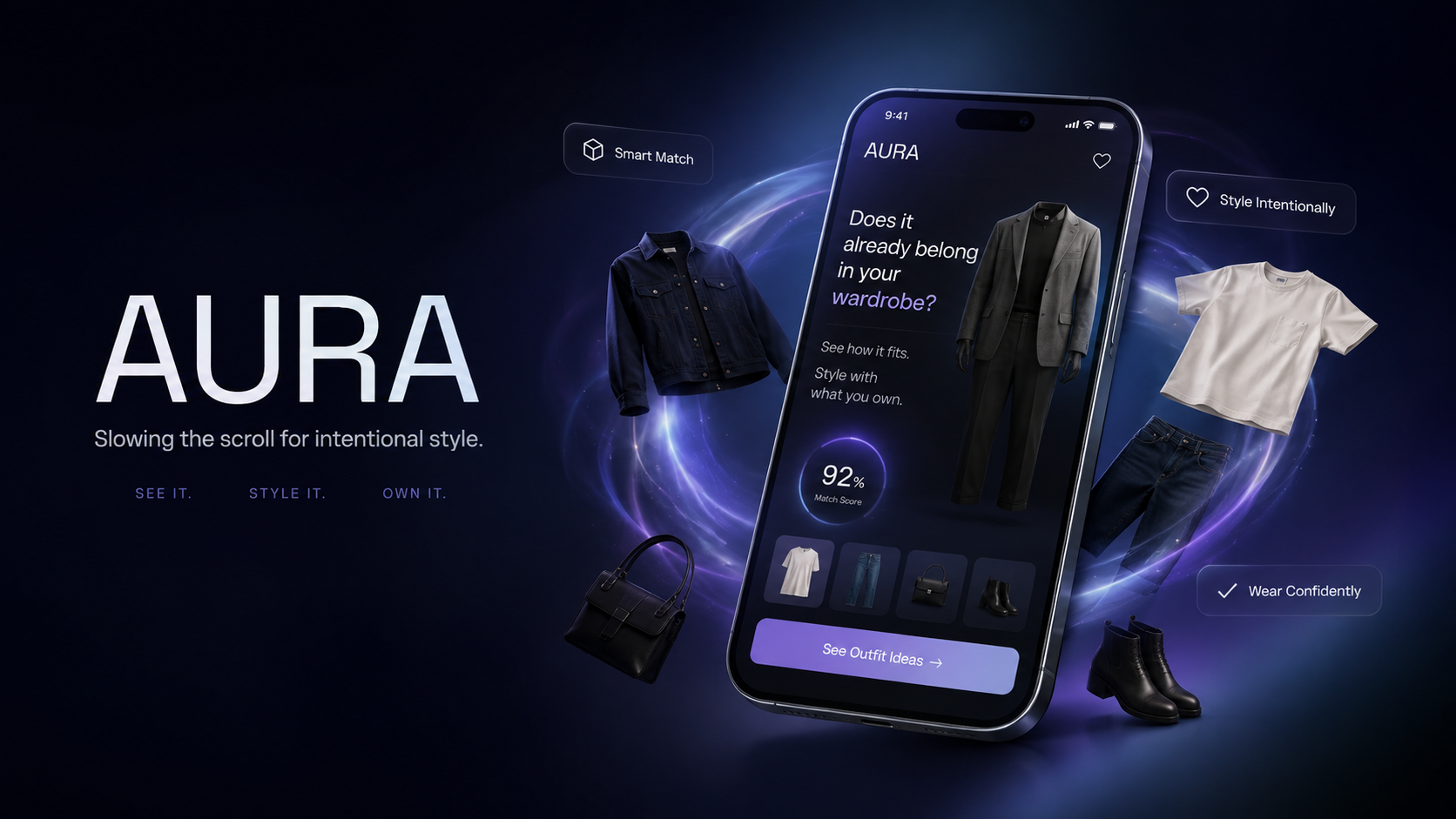
The problem in context
Fashion e-commerce is optimised for one number: conversion. Recommendation engines learn what you'll click, not what you'll actually wear. Trend feeds refresh faster than any wardrobe can absorb. The result is a generation that owns more clothes than any before it and still opens the closet each morning unsure of what works.
The interviews kept returning to the same feeling — wardrobe blindness. Users knew their closet was full, but couldn't picture what they had. So they bought again, on impulse, chasing a trend they'd already half-owned. AURA started from a stubborn premise: the real problem isn't buying clothes. It's not knowing what already works inside your wardrobe.
History — what came before
Every step of fashion's digital evolution optimised discovery — and quietly worsened decisions.
Pinterest boards, mirror selfies, and friends on WhatsApp are the workarounds people invented because no product actually helps them decide. Recommenders solved discovery. They never solved compatibility.
More recommendations weren't the answer. Better decisions were.
Geography — where it lives
The problem lives on the phone of a 19–28 year old in urban India — college students, early-career professionals, creators. Myntra, Instagram, and Pinterest are the fashion operating system; a purchase decision is usually made in bed, in under two minutes, against a wardrobe the user can't currently see.
Friction concentrates in three places: on the product page (does this go with anything I own?), at checkout (am I sure?), and forty-eight hours later (why did I buy this?). AURA had to sit inside that journey, not beside it — mobile-first, Myntra-parity, and fast enough not to become the reason a user abandoned the flow.
Physics — forces at play
Every purchase decision is a tug-of-war between forces pulling toward the cart and forces pulling back.
- Trend pressure and social proof
- Fear of missing out on limited drops
- Sale timers and price anchoring
- Influencer aesthetics as aspiration
- Curiosity — the pull of the new
- Wardrobe blindness — not remembering what's owned
- Decision fatigue from infinite scroll
- Doubt about fit, colour, and pairing
- Return friction and refund anxiety
- Guilt about unused clothes at home
AURA doesn't try to kill the driving forces — trend curiosity is human. It amplifies the opposing ones with intelligence: a compatibility score, an outfit that already uses three items you own, a moment of clarity right before "Add to bag."
Chemistry — what reacts together
The old loop runs on autopilot: a reel triggers desire, the app makes purchase effortless, doubt arrives after delivery, the item is worn once and forgotten. Regret quietly compounds; the next trend resets the cycle before the last one is understood.
AURA breaks the chain at the third link. The compatibility check surfaces beforethe doubt does — turning a private hesitation into a visible answer. Curiosity survives; the loop that ends in regret does not.
Biology — the living system
Shopping is a habit loop, not a decision. Cue, routine, reward — repeated until the wardrobe overflows. Changing behaviour meant changing what the reward feels like.
Trend → Buy → Wear once → Forget → Repeat.
Need → Compatibility check → Outfit suggestions → Confidence → Purchase → Reuse → Reward.
The reward shifts from the dopamine of buying to the confidence of wearing. Gamification reinforces reuse, not acquisition — the streak you're proud of is styling what you own.
Mathematics — the numbers
- Repeat usage of wardrobe intelligence beyond 30 days
- Reuse rate — outfits generated from existing wardrobe vs new purchases
- Return-rate reduction on AURA-assisted purchases
- Sustained engagement with the gamification loop
"I already own something like this — I just couldn't remember. That's the thing I keep needing."— Participant, 23, prototype session 07
Design engineering
Eight decisions shaped the product.
- Mobile-first, Myntra-parityUsers already know the mental model. Fighting it would have burnt every second we needed for the AURA-specific surfaces.
- Wardrobe-first onboardingThe first screen after sign-up isn't the store — it's the closet. The product's core signal has to exist before it can help anyone.
- Compatibility score as first-class UIA single number, visible on every product card, becomes the shortcut for a decision users used to outsource to friends.
- Outfit generation over product recsRecommend combinations, not items. An outfit answers the actual question — 'what do I wear this with?' — that a product page never does.
- Gamified reuse, not acquisitionStreaks and rewards reinforce styling what you own. The mechanic rewards the behaviour the product is trying to build.
- Explainable AI surfaceEvery suggestion carries a plain-language 'because'. Trust in AI collapses the moment it feels arbitrary.
- Empty, loading, success, error statesA wardrobe with three items has to feel possible, not embarrassing. Each state was designed, not defaulted.
- Design tokens + accessibilityAA contrast, tap targets sized for one-thumb use, and a token system so the AI surfaces still feel like the shopping app around them.
STAR — situation, task, action, result
A 2-week hackathon brief on sustainable fashion. Every competing team went straight to 'buy less' messaging. Interviews told us users didn't need a lecture — they needed a decision tool.
Design a mobile-first shopping experience that reduces impulse purchases without sacrificing the fun of discovery, and prove it inside a working prototype in under two weeks.
As Junior Product Designer in a team of five, I owned the wardrobe and compatibility flows. Ran interviews, mapped the impulse loop, wireframed the compatibility score, prototyped the outfit generator, and iterated twice against usability sessions.
A validated concept where users made faster, more confident decisions and reported fewer regretful buys. The bigger shift was internal: we stopped designing for more purchases and started designing for better ones.
Before & after
The shift is structural, not cosmetic.
| Before | After |
|---|---|
| Shopping driven by trends | Shopping guided by wardrobe intelligence |
| No visibility into what's owned | Compatibility score on every product |
| Impulse add-to-cart | Confident, considered purchase |
| Regret after delivery | Reuse and remixing at home |
| Wardrobe clutter | Gamified reuse of existing pieces |
| Decision fatigue | Guided decision in under a minute |
Final screens
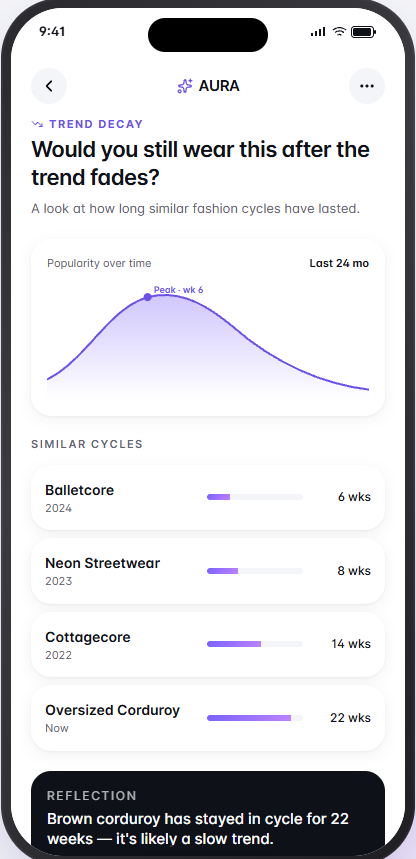
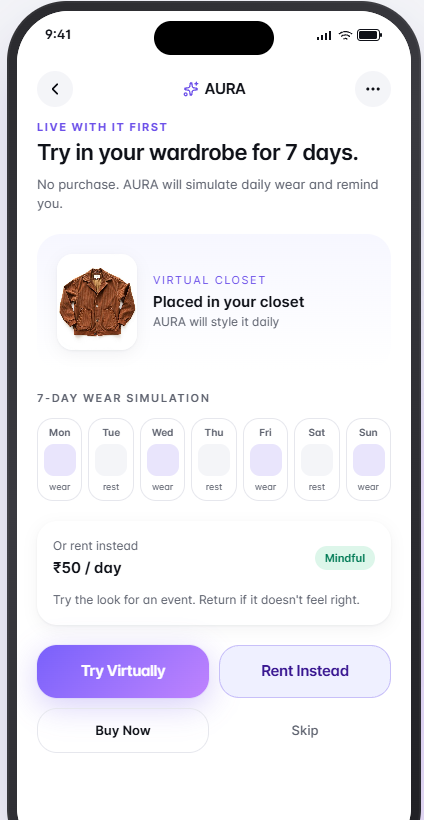
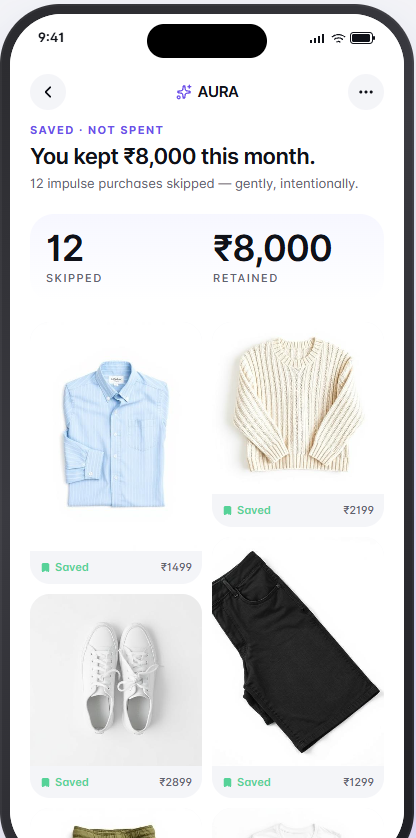
Fifteen surfaces do the work — from first launch to a purchase the user won't regret.
- SplashA quiet opening — sets the tone that this is a tool for decisions, not a store racing to sell.
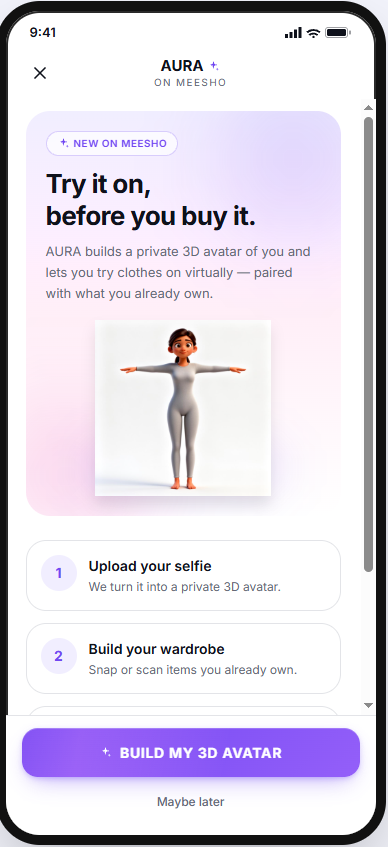
- OnboardingThree screens that reframe the product: this app knows your closet first, the store second.
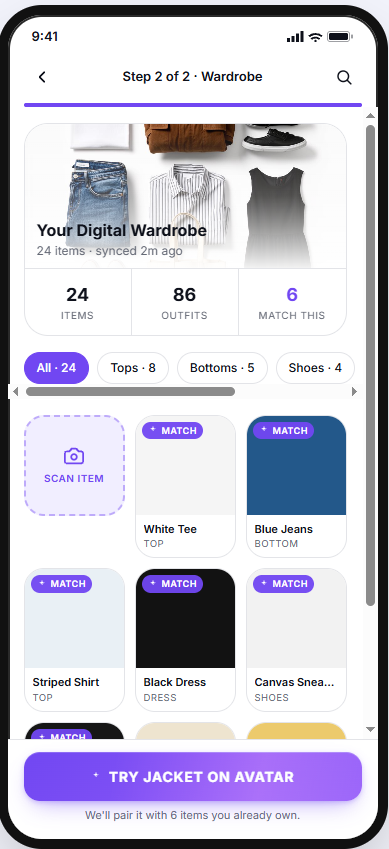
- Wardrobe UploadPhoto or manual add — the lowest-friction path to a usable wardrobe on day one.
- Closet ScanAI parses images into categories, colours, and silhouettes so the user isn't tagging everything by hand.
- AI AnalysisA transparent 'thinking' state that shows what's being extracted. Trust starts with visibility.
- Wardrobe DashboardThe user's closet, made searchable and browsable — often the first time they've truly seen it.
- Product DetailsStandard Myntra-style page, with one new anchor: the compatibility score at the top.
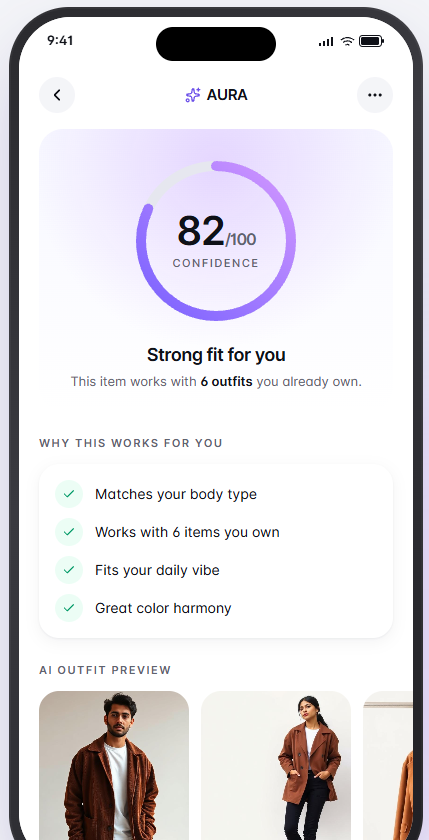
- Compatibility ScoreA single number plus a plain-language 'because' — the decision moment, made legible.
- Outfit SuggestionsAI-generated outfits that pair the product with items already in the wardrobe. This is the pitch.
- Alternative RecommendationsIf the item scores low, the app suggests better-matching alternatives — respecting intent, not blocking it.
- Gamification DashboardStreaks, missions, and levels tied to reuse and confident buys, not spend.
- AchievementsBadges reward wardrobe utilisation — the metric that actually maps to buying better.
- Purchase ConfirmationCloses the loop with the outfits this new piece unlocks. The reward is the wear, not the ring.
- ProfileStyle DNA, preferences, and history — the foundation the AI keeps learning from.
- SettingsControls for notifications, data, and AI transparency — the user stays in charge of the intelligence.
Learnings
The brief said 'sustainability'; the interviews said 'confidence'. Following the users, not the brief, changed the entire product.
A compatibility score works only because it's a single number. Every additional layer we prototyped diluted the decision it was meant to make.
Impulse isn't defeated by friction; it's defeated by a better answer arriving before doubt does. AURA had to be faster than hesitation.
Optimising for confidence is a different product than optimising for conversion. You can't do both from the same screen — we picked.
Even a hackathon-scale AI has to explain itself. An unexplained suggestion tested worse than no suggestion at all.
Buying less isn't anti-commerce. Users who trust the tool return more often and return fewer items — the economics quietly work.
Five people, two weeks, one insight to defend. The value of the project came from what we agreed to leave out.
Validate reuse and return-rate impact over a real cohort. Extend the wardrobe model to shoes, accessories, and second-hand marketplaces. Test social features carefully — the last thing this product should become is another feed.
People don't need more fashion choices. They need more confidence in the choices they make.